ALDIUM Insurance
Cover built for UK scaffolding contractors — liability at the height limits you actually work to, plus scaffolding stock, plant and vehicles, arranged around the sites you take on.
Tell us about your business and one of our trade insurance specialists will come back to you. Whether you work on domestic jobs or hold contracts on commercial sites, we approach our panel of insurers and present your business properly — so the terms you receive reflect the heights and the work you actually take on.
Request your quote
Tell us a little about your business and a trade specialist will be in touch.
Your details are used only to prepare your quotation and are never sold on. Aldium Insurance Services Ltd is authorised and regulated by the Financial Conduct Authority (FCA No. 306687).
Scaffolding insurance is a package of commercial covers designed for scaffolding contractors. A typical policy combines public and products liability, employers’ liability for firms with staff, cover for scaffolding stock and equipment, plant and commercial vehicle insurance. Almost every policy carries a height limit, and employers’ liability is a legal requirement in the UK for almost any scaffolding business that employs people, with a minimum limit of £5 million.
Scaffolding sits at the high-risk end of the construction trades. Work happens at height, above public footpaths and neighbouring property; the structure stays up for weeks with other trades using it; and a single dropped fitting or a scaffold that moves in high wind can turn into a serious injury claim. Insurers price the trade accordingly, and they set conditions that other trade policies do not carry.
Most scaffolding policies specify a maximum working height — commonly tiered at levels such as 10 metres, 15 metres, 20 metres, or unlimited. It is the single most important term on the schedule. If a loss happens on a job that exceeds the height stated on your policy, insurers may decline the claim entirely, however well the scaffold was built. A cheaper premium frequently reflects a lower height limit rather than a better deal.
Aldium is an independent broker arranging cover for UK trade and contracting businesses, from single-gang scaffolders to established contractors running multiple sites — building each policy around the heights worked and the sites taken on.

A scaffolding insurance policy is built from separate sections that work together to protect your liabilities, your people, your stock and the vehicles that move it. The covers typically available to UK scaffolding contractors include:
Covers claims for injury or property damage caused by your work — falling tube or fittings, debris, or a scaffold striking a building or vehicle. £5m and £10m are the usual limits for scaffolders, and the policy will state a maximum working height.
A legal requirement if you employ staff, including apprentices and most labour-only subcontractors. The statutory minimum is £5 million; scaffolding contracts frequently require £10 million.
Covers your tube, fittings, boards, system scaffold, ties and sheeting against theft, loss and damage — at your yard, in transit, and while erected on site. Usually the largest single asset a scaffolding firm owns.
Covers owned plant such as telehandlers and hoists, and hired-in plant including the continuing hire charges you remain liable for while a damaged machine is off hire.
Cover for flatbeds, tippers, vans and lorry-mounted cranes, from a single vehicle to a fleet — including goods in transit for stock moving between yard and site.
Protects hand tools, power tools and small equipment against theft, loss or damage. Cover for tools left in vehicles overnight is usually subject to security conditions set out in the wording.
Relevant where you take on design responsibility — a bespoke scaffold design outside standard configurations, or advice on a temporary works scheme. Public liability responds to damage, not to a design that proves inadequate.
Legal advice and representation for employment disputes, contract disagreements, debt recovery and HMRC enquiries — plus support with health and safety prosecutions, a real exposure in work at height.
These are brief descriptions of covers typically available to UK scaffolding contractors, provided for general information only. All policies are subject to their own terms, conditions, limits, excesses and exclusions — including height limits — please refer to the policy documentation for full details. Aldium Insurance Services Ltd is authorised and regulated by the Financial Conduct Authority (FCA No. 306687).
Comparison sites sell policies by the month. We arrange cover — which means understanding the heights you work to and the sites you take on before we go anywhere near the market.
Aldium is an independent brokerage. We present your business to the market on your behalf and recommend the cover that fits the work you do — not the policy an insurer wants to sell. And there are no call centres: you deal with named people who know your account.
We place cover across a broad panel of trade and contractor insurers, including schemes not available on the open market. That access means we can influence how your business is presented, negotiated and priced — rather than simply passing on the quotes everyone else can get.
The height limit on a scaffolding policy decides whether a claim is paid, and a limit set too low is the most common gap we see. We’re used to arranging cover that reflects the heights you actually work to — including unlimited height where the work calls for it.
A claim usually lands at the worst possible moment — a fire on a part-finished build, storm damage to open works, or plant stolen from site. Our in-house claims manager handles the process on your behalf, reporting, evidencing and chasing your claim, so you can get back to work.
We arrange insurance for scaffolding businesses across the UK — whether you run a single gang on domestic jobs, hold contracts on commercial sites, or hire out stock as well as erecting it.
Single-gang operators needing liability, stock and vehicle cover.
Businesses employing scaffolders, apprentices or labour-only subcontractors.
Housing work, roof jobs and extensions, usually at lower height limits.
Site work for main contractors, often requiring £10m limits and higher heights.
Firms hiring out stock as well as erecting it, where materials are the main asset.
Specialist access work, temporary roof systems, shrink wrap and edge protection.
Taking on taller work, or asked for higher limits by a main contractor? We regularly arrange cover for scaffolding firms moving from domestic into commercial work, and for those needing an increased or unlimited height limit — talk to us about your circumstances.
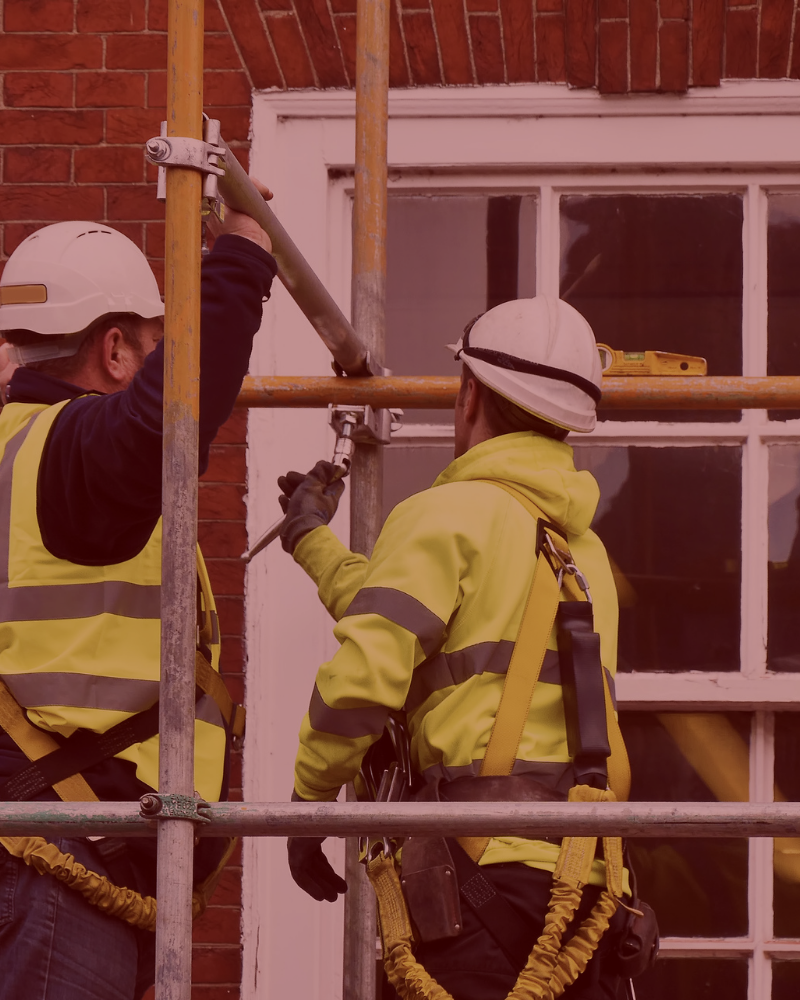
Scaffolding policies look similar until you read the conditions, and this is a trade where the conditions do most of the work. Under the Insurance Act 2015 every business has a duty of fair presentation to its insurers, so accurate information — heights worked, stock values, activities undertaken — sits with you as the policyholder. These are six areas worth looking at closely.
Nearly every scaffolding policy states a maximum working height, often tiered around 10, 15 or 20 metres, with unlimited height available at a price. It is the term most likely to decide a claim. Take on one job above the stated limit — even briefly, even well built — and insurers may decline a loss on that site entirely.
Standard configurations can be built to recognised industry guidance without a bespoke design. Anything outside those parameters — unusual loadings, complex geometry, temporary roofs, heavy duty or long spans — typically needs a bespoke design by a competent engineer. Taking on that responsibility moves the exposure towards professional indemnity, which most scaffolding policies do not include as standard.
Under the Work at Height Regulations 2005, scaffolding must be inspected before first use, at intervals not exceeding seven days, and after alteration or anything likely to have affected its stability, such as high winds. Those inspection records and handover certificates are the evidence that defends a claim — and their absence is what makes one hard to defend.
A scaffold can be up for weeks with other trades using it, altering it or overloading it. Your liability does not end when the gang leaves site. Unauthorised alteration by others, missing ties, removed boards and third-party interference are common causes of loss, and how your policy treats a scaffold erected but not currently worked on is worth knowing.
Ties and anchors drilled into a facade, damage to render, roof coverings or windows — that is damage to property in your care, custody or control, and liability policies commonly restrict or exclude it. Where a contract makes you responsible for the building, the wording needs to reflect that before you start.
Tube, fittings, boards and system scaffold represent a serious asset, and replacement values have moved considerably. Cover is usually split between stock at your yard, in transit and erected on site, often with different limits and security conditions for each. Sums insured rolled forward from an old schedule are one of the most common gaps in the trade.
This section is general information for UK scaffolding contractors, not advice on your individual circumstances — appropriate limits, covers and conditions depend on the work you carry out and the contracts you sign, and responsibility for the accuracy of information disclosed to insurers rests with the policyholder. If you would like to talk any of these areas through, our team is on 0151 336 5881.

No comparison-site forms, no call centres — just a straightforward process handled by people who understand contracting businesses.
Complete the short form above or call us. We’ll ask about the work you do, your turnover, staff and subcontractors, the heights you work to, your scaffolding stock, vehicles and claims history — the details insurers price on.
A short phone callWe present your business to our panel of trade and contractor insurers — including schemes exclusive to us — so underwriters see a real business, not just a set of tick boxes.
We do the legwork for youWe talk you through the options — covers, limits, excesses, conditions and premium — in plain English, and check the height limit and liability limits line up with the work you take on.
At your paceOnce you’re happy we place cover and confirm your documents. From then on you have a named contact for mid-term changes — a new employee, a taller job, extra stock — and our in-house claims manager if you need to claim.
All year, not just renewalWhat you’ll need to hand: your estimated annual turnover, the split between domestic and commercial work, how many people you employ (including labour-only subcontractors), the maximum height you work to, the value of scaffolding stock you own, your vehicles, the liability limits your contracts require, and details of any claims in the last five years. If you don’t have all of it, we’ll work through it with you.
Don’t just take our word for it — here’s what businesses across the UK say about Aldium on Google.
EXCELLENT
Based on 50 reviews
Posted on Google![]()
Radu GramadaTrustindex verifies that the original source of the review is Google.
4th year with Aldium and getting better by the day. The team is always working in the background and the result are incredible. Really comprehensive and detailed explanations on why some insurers are better then other and quality advice offered along with multiple choices of cover. Every year we are getting more benefits and better prices. Would stronly recommend.Posted on Google![]()
Ron JonesTrustindex verifies that the original source of the review is Google.
Renewal was done with no problems at all -quicky ,efficiently and professionally and to my likingPosted on Google![]()
Keith LindsayTrustindex verifies that the original source of the review is Google.
I have been very satisfied with the cover arranged for me and am impressed with the personal needs assessment and discussion of alternatives. Very pleasent experience, to which I will return.Posted on Google![]()
Donna LawsonTrustindex verifies that the original source of the review is Google.
Fabulous company and wonderful staff. Whatever we need in Insurance is explained so that we understand all.Posted on Google![]()
Mark HughesTrustindex verifies that the original source of the review is Google.
Really thorough quote, covered thing are previous brokers had never discussed, very happy with the service.Posted on Google![]()
stewart baileyTrustindex verifies that the original source of the review is Google.
Aldium have been a constant supplier for our vehicle insurances for a number of years. Nothing is ever too much trouble when replacing vehicles, or indeed when we just need a bit of advice regarding explanation of terms or such like. When policy renewal time comes around, they don't contact us until they've done their homework and have sourced the best value policy available for our needs, at the best possible price. Thank you to everybody at Aldium, we have no intention of looking elsewhere for our insurance provider.Posted on Google![]()
Paul ThompsonTrustindex verifies that the original source of the review is Google.
Great customer service, highly recommended!Posted on Google![]()
Ron PassinghamTrustindex verifies that the original source of the review is Google.
Very helpful and patient. A reasonable quote which we accepted. Will use them again.Posted on Google![]()
Barry SheardTrustindex verifies that the original source of the review is Google.
Excellent unbiased informationPosted on Google![]()
Richard LewisTrustindex verifies that the original source of the review is Google.
Hard to beat for service, I tried a couple of competitors before finding Aldium, the difference in attitude was stark, competitors, disinterested and generally unhelpful, found Aldium online, friendly helpful and knowledgeable, sorted everything out without any fuss and I am happy to now be a happy customerVerified by TrustindexTrustindex verified that these reviews were published on Aldium Insurance Services Ltd's Google Business Profile. Learn more
There is no standard price for scaffolding insurance in the UK. Premiums are calculated individually by insurers based on factors including the maximum height you work to, your annual turnover, whether you employ staff or subcontractors, the liability limits your contracts require, the value of scaffolding stock and vehicles insured, and your claims history — and because scaffolding is treated as a higher-risk trade, rates sit above those for most other trades.
Usually the biggest single factor for a scaffolder — moving up a height band, or to unlimited height, changes the rate.
Reflects how much work you do and therefore your exposure; the main rating basis for liability cover.
Wageroll, the number of scaffolders and how subcontractors are engaged all feed into employers’ liability pricing.
Moving from £5m to £10m — often to satisfy a main contractor — affects the premium.
The replacement value of tube, fittings, boards and system scaffold, and where it is kept when not in use.
Domestic housing, commercial sites, industrial work, temporary roofs and shrink wrap each carry a different profile.
How many flatbeds and tippers you run, whether you operate lorry-mounted cranes, and who drives them.
Your record over the last five years, and what has changed since, influences how insurers rate the risk.
Documented inspection regimes, training records and industry card scheme qualifications all help demonstrate how you work.
A note on price: the cheapest premium is not always the most suitable cover — a lower quote very often reflects a lower height limit, tighter stock conditions or a restricted definition of your activities, any of which can matter far more when you come to claim than a saving at renewal. As independent brokers we search our panel of trade insurers to find cover that balances protection and price for your business. Request a tailored quotation or call 0151 336 5881.
The questions scaffolding contractors ask us most often. If yours isn’t here, call us on 0151 336 5881 — a real person will pick up.
Employers’ liability insurance is a legal requirement under the Employers’ Liability (Compulsory Insurance) Act 1969 if you employ anyone, with a minimum limit of £5 million. The Health and Safety Executive can fine businesses up to £2,500 for each day they trade uninsured. Public liability is not required by law, but no main contractor, local authority or commercial client will let a scaffolding firm on site without it.
It is the maximum height at which your policy covers you to work, stated on the schedule and commonly tiered around 10, 15 or 20 metres, with unlimited height available. It is the most important term on a scaffolder’s policy: if a loss occurs on a job above the stated height, insurers may decline the claim. If you take on taller work than usual, it needs to be agreed with your insurer before you start.
£5 million and £10 million are the usual limits for scaffolding contractors, reflecting the seriousness of a fall, a collapse or falling debris. Main contractors, local authorities and housing associations commonly require £10 million before allowing you on site. Because the requirement is set by the contract rather than by your insurer, check the insurance clause in each agreement.
Usually yes, but often on different terms from stock at your yard. Policies typically split cover between materials at your premises, in transit, and erected on site, each with its own limit and security conditions. Because tube, fittings and boards represent a substantial asset, and replacement values have risen, sums insured carried over from an older schedule are a common source of underinsurance.
Your liability generally continues while the scaffold is erected, not just while your gang is on site. Other trades using it, unauthorised alteration, removed ties or boards, and third-party interference are all common causes of loss. How your policy treats a scaffold that is erected but not currently being worked on is worth confirming, particularly on jobs where the scaffold stands for several weeks.
Not always, but increasingly often. Standard configurations can generally be built to recognised industry guidance without a bespoke design. Where a scaffold falls outside those parameters — unusual loadings, complex geometry, temporary roofs or long spans — a bespoke design by a competent engineer is normally required, and taking on that design responsibility is a professional indemnity exposure rather than a public liability one.
Under the Work at Height Regulations 2005, scaffolding must be inspected before it is first used, at intervals not exceeding seven days while it remains in place, and after any alteration or event likely to have affected its stability, such as high winds. Inspection records and handover certificates are also the evidence that defends an insurance claim, so keeping them properly matters commercially as well as legally.
Often only in limited terms. Damage to the property you are working on — render, roof coverings, windows, or the fabric around ties and anchors — may fall under a care, custody or control restriction in a liability policy. Where a contract makes you responsible for the building, it is worth establishing how your wording treats it before work starts.
There is no standard price. Premiums are calculated individually based on the maximum height you work to, your turnover, whether you employ staff or subcontractors, the liability limits your contracts require, the value of stock and vehicles insured, and your claims history. As independent brokers we approach our panel of trade insurers to find cover that balances protection and price for your business. Request a tailored quotation to find out what that means for you.
Complete the short form on this page or call us on 0151 336 5881. It helps to have your annual turnover, the maximum height you work to, how many people you employ, the replacement value of your scaffolding stock, your vehicles and details of any claims in the last five years. We then approach our panel of trade insurers and talk you through the options in plain English. There’s no obligation at any stage.
Whether your renewal is coming up, a client has asked for evidence of higher limits, or you have taken on work above the height your policy allows, challenge us to take a look. We’ll talk through what you have now and show you what our panel of trade insurers can offer. No obligation, no call centres, just straight answers.
Also for the trades: Builders insurance · Electrical contractors insurance · Tradesman insurance
Aldium Insurance Services Ltd · Viscount House, High Street, Neston, CH64 9AD · Independent commercial insurance brokers for UK trade and contracting businesses.
Aldium Insurance Services Ltd is authorised and regulated by the Financial Conduct Authority (FCA No. 306687) and registered in England and Wales (No. 3278618). The information on this page describes covers typically available to UK scaffolding contractors and is provided for general information only — it is not advice on your individual circumstances. All policies are subject to their own terms, conditions, limits, excesses and exclusions; please refer to the policy documentation for full details.
Viscount House, High Street
Neston, CH64 9AD
Call – 0151 336 5881
New Enquiries – Quote@Aldium.co.uk
Existing Customers – Mail@Aldium.co.uk
© 2026 ALDIUM Insurance Services Ltd Registered Office: Viscount House, High Street, Neston, CH64 9AD Registered in England and Wales 3278618. Authorised and regulated by the Financial Conduct Authority (FCA No 306687).